






















Understanding Take-Up & Shrinkage in Weaving

Weaving is a dance between tension, texture, and transformation. Each thread carries potential, and every pass of the shuttle brings you closer to the fabric you've envisioned. Yet, even the most experienced weavers sometimes find that their finished piece doesn't quite measure as planned. The culprit? Three subtle yet powerful forces: take-up, shrinkage and draw in.
These factors are often misunderstood, but they're quintessential to asuccessful weaving project. Understanding how and why fabric dimensions change, and learning to anticipate those changes, allows you to weave your fabric to the width and length you desire.
In this guide, we'll touch lightly on draw-in, explore what take-up and shrinkage mean, the key variables that affect them, and how you can calculate and plan for these changes in your weaving projects. With mindful preparation, and perhaps some sampling, you can transform weaving surprises into consistent, satisfying results — a reflection of craftsmanship and respect for your materials.
What is Take-Up and Shrinkage in Weaving?
Before we dive deeper, let's define these three important terms.
Take-up refers to the shortening of the warp threads during the weaving process. As the weft passes over and under, the warp bends around it, consuming a little extra length each time. This seemingly invisible consumption means that even though your warp may have been measured precisely, the woven fabric will be shorter than your initial warp length.
Shrinkage, on the other hand, occurs after weaving, which would be during washing, wet finishing, or pressing. It happens when fibres relax, tighten, or contract once they're released from the loom's tension and exposed to moisture or heat. This can affect both the fabric's length and width.
Draw-in is similar to “take-up” in that there is a natural narrowing of the weaving at the selvedge (edges of weaving) due to the weft going over and under the warp yarn. All weaving has draw-in to some extent and can be predicted and planned for in the sampling phase. It should be noted that excessive draw-in can happen when the weft is placed too tight and we will discuss ways you can minimise draw-in in a future article.
Together, draw-in, take-up and shrinkage can significantly influence your final dimensions. Even a 5–10% difference in any of these factors can make or break a project requiring precise measurements.
It is important to understand that this shrinkage is not something to perceive as a problem. They're natural, expected characteristics of woven cloth. Learning to predict and manage them gives you greater control and helps you weave with both creativity and confidence.
Key Factors That Influence Take-Up and Shrinkage
Several interconnected elements determine how much your fabric will change from loom to finished cloth. Understanding these variables will help you plan for dimensional shifts and avoid unexpected results.
Yarn Fibre and Type
Every fibre behaves differently, shaped by its natural structure and how it responds to water, tension, and finishing.
- Cotton — Organic Egyptian cotton yarn typically shows moderate shrinkage. It softens and settles beautifully after washing, making it ideal for towels, garments, and home textiles.
- Linen — Raw organic linen has little elasticity and minimal shrinkage. Still, it benefits from wet finishing to relax the fibres and develop its characteristic drape and sheen.
- Wool — Harrisville Designs Shetland Wool will full and shrink substantially when finished by agitating in hot soapy water. This property can be harnessed to create soft, lofty fabrics or controlled to retain structure.
- Silk — 30/2 Mulberry Spun Silk behaves beautifully; It exhibits minimal shrinkage and responds predictably to loom tension and finishing, producing an elegant, smooth cloth.
Because each yarn reacts differently, sampling is key. Weave and wash a small swatch in the same way you intend to finish the final fabric. This practical step will help you anticipate how much your chosen fibre will contract or soften.
Weave Structure and Density
Your choice of weave structure has a significant impact on take-up and shrinkage.
Structures with greater interlacement, such as plain weave, consume more yarn as threads pass over and under one another more frequently, increasing take-up and often resulting in greater shrinkage during finishing. Structures with fewer interlacements, seen in twill, basket weave, or waffle weave, typically exhibit less reduction because the yarns have space to move and settle more
Sett, the number of warp ends per centimetre or inch, strongly influences shrinkage. At a more open sett, yarns have greater freedom to move and rearrange during wet finishing, often resulting in increased shrinkage, particularly in width. In contrast, a denser sett packs the threads closely on the loom, limiting their ability to shift or swell and generally leading to less shrinkage.
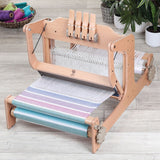
If you're working on an Ashford Table Loom, you can easily experiment with multiple structures on a single warp. We recommend a straight or point twill threading, as both lend themselves to a wide range of patterns and variations. Recording how each structure behaves allows you to compare results directly. Sampling different setts and weaves on your loom builds a valuable library of reference fabrics for future planning.
Tension on the Loom
Loom tension is a subtle but critical factor in managing take-up and shrinkage. When the warp is wound too tightly, the fibres are stretched during weaving. Once off the loom and relaxed, they will likely contract, which will lead to additional and unexpected shrinkage.
Balanced tension across the warp helps prevent distortion and ensures the warp and weft interlace evenly. On larger floor looms, such as the Leclerc Fanny II Loom, and/or with longer warps, this balance becomes especially important. Variations in tension can be magnified across wide warps, making consistent monitoring and adjustment essential. Consider the use of warp weights for errant threads.
Keep notes throughout your projects. Recording details such as tension adjustments and how the fabric behaves off the loom builds a valuable reference that improves accuracy in future work.
Finishing Methods
Finishing transforms woven cloth into usable fabric. Washing, fulling, pressing, or steaming—each process can significantly alter a cloth’s size and hand.
For instance, woollen fabrics are fulled with hot, soapy water and agitation, causing shrinkage as the fibres begin to felt. The degree of shrinkage and felting can be controlled by regularly checking the process. Silks, by contrast, require gentler handling to maintain their lustre and drape. Even smooth fibres such as cotton or linen undergo subtle dimensional changes as they relax from weaving tension and are exposed to water.
Always wet-finish your test swatches in the same manner you plan to finish your final fabric. Note how much they change and document the final measurements. Over time, these records will form a reliable reference for future work.
How to Calculate Take-Up and Shrinkage
Knowing how to calculate these changes helps you plan warp lengths accurately and ensure your final project turns out as expected. You will need to sample to get truly accurate calculations but if your garment doesn’t require precise measurements, you may wish to use an average guess of 10-20% (higher for high-shrink fibres and structures) as a starting point.
Note: We understand the math we’re about to discuss can feel overwhelming. If you’d like help keeping track of these calculations, we encourage you to download our Cheat Sheet and Project Planning Worksheet.
Basic Formulas

Example Calculation
Imagine your measured warp is 200 cm. After weaving, before washing, your fabric measures 185 cm.
Take-up = ((200 – 185) ÷ 200) × 100 = 7.5%
After washing and finishing, it measures 175 cm.
Shrinkage = ((185 – 175) ÷ 185) × 100 = 5.4%
Stacking the percentages obtained gives 12.9%, but measured from start to finish the total reduction is 12.5%. If you'd planned for this, your warp could have been adjusted to produce a finished piece exactly the size you wanted.
You can then go one step further (if you wish) and create a planning ratio (Start → Finish). Rather than stacking percentages, plan using a ratio based on what you started with versus what you ended with.
Planning Ratio = Measured Warp Length ÷ Finished Fabric Length
Example: Beginning warp length: 200 cm Finished fabric length: 175 cm
200 ÷ 175 = a planning ratio of 1.143
Putting the ratio into action: Desired Finished Length × Planning Ratio = Length to Weave
Using the above formula to end up with 150 cm when the fabric is woven and finished, you would need to weave 171.45cm (150 x 1.143 = 171.45). This same ratio works in inches.)
To measure accurately, pin your samples flat using T-pins (T-Pins – Pack of 50 Pins) before washing and again after drying. This ensures your calculations reflect real, comparable measurements.
Tips for Planning Your Weaving Projects with Precision
Here are some practical ways to manage take-up and shrinkage in your weaving projects:
- Add allowances to your warp. If you choose to skip sampling and doing the maths include an extra 10–15% of length to account for take-up and shrinkage, especially for wool and other high-shrinkage fibres. It’s good practice to also add a little extra to each warp to allow for sampling
- Keep a weaving journal. Record fibre type, sett, tension, weave structure, and finishing results for every project.
- Sample before you start. Always weave and finish a test swatch before committing to full warp lengths.
- Block accurately. Use T-pins to keep the fabric square when drying, ensuring consistent measurements.
- Learn from your materials. Over time, your yarns will teach you how they behave. Respecting their natural tendencies leads to better, more harmonious results.
If you're planning your next weaving project and want to calculate how much yarn you'll need, see our detailed guide on Yarn Requirements for Weaving.
Ready to Weave with Confidence and Intention?

Take-up and shrinkage are natural parts of the weaving process and are not flaws to fear, but beautiful reminders that fibres have movement and are responsive. By understanding these changes and planning for them, you'll gain control over your results while staying connected to the organic, evolving nature of your materials.
Each warp and weft tells a story of transformation — from tension to release, from anticipation to satisfaction. With mindful preparation, a little math and the right tools, you can weave fabrics that turn out exactly as you envisioned, full of texture, purpose, and care.
At Thread Collective, we share your passion for precision, sustainability, and creativity. Our curated selection of looms, natural yarns, and thoughtful weaving tools is here to support you at every stage of your making journey. Together, let's continue weaving with awareness, beauty, and craftsmanship — one intentional thread at a time.
Share this article on your favorite platform:
Table of Contents

2 comments
This is a fabulous guide…especially for beginners like me. Thank you!
Enjoyed this article. I’ve woven fabric and get to the end and it’s not as long as I’d worked out. Will definitley add more warp to compensate next time. Good clear calculations too. Thankyou.